 Skip to the content
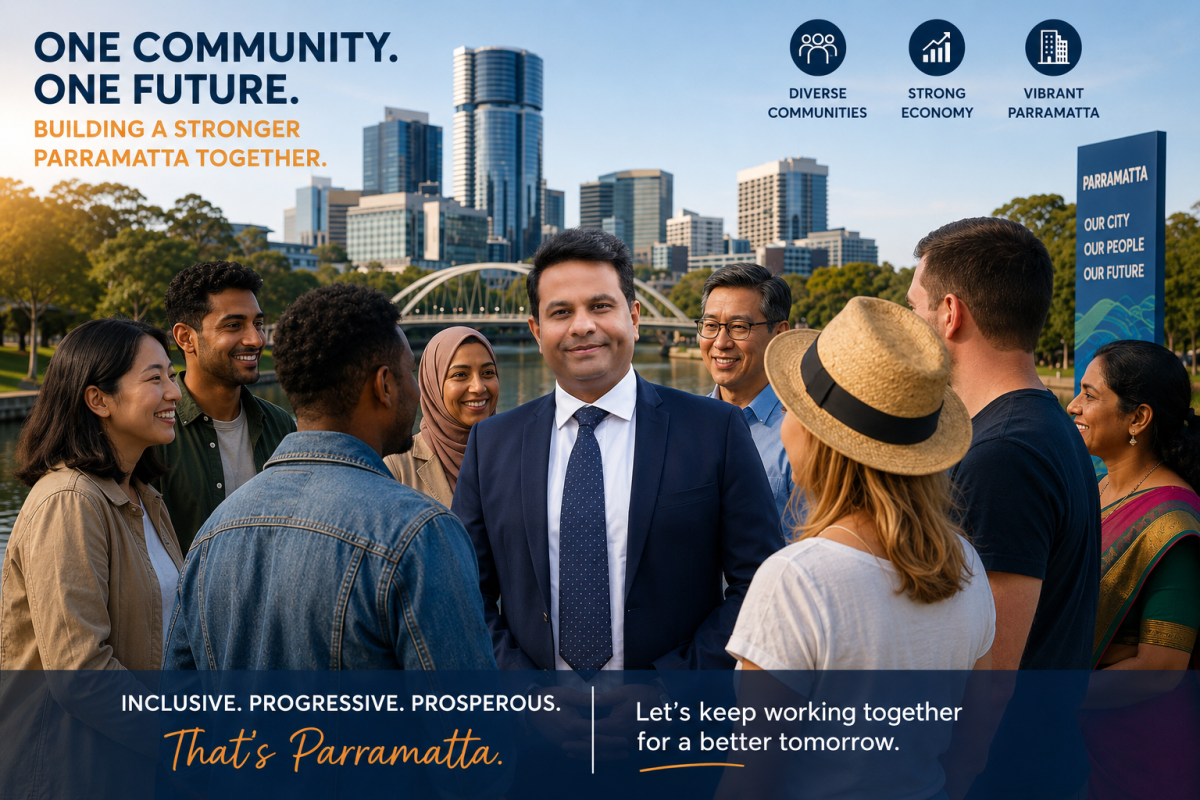
Walk through Parramatta on any given week and you will hear more than one language at the shops, see families celebrating different traditions in the same park, and meet small business owners whose stories began in every corner of the world.
That is why the importance of multiculturalism in Australia, and how it has changed the Parramatta electorate, are not abstract debates here.
It is visible in our streets, our schools, our places of worship, our sporting clubs and the everyday expectations residents have of local government.
For Parramatta, multiculturalism is not a slogan. It shapes how council communicates, how services are delivered, how community events are planned and how local leaders listen.
It also changes what residents rightly expect from their representatives. People want to be heard, respected and included, no matter where they were born, what language they speak at home or how long they have lived in the area.
Why multiculturalism matters in Australia
Australia has been shaped by migration for generations, but multiculturalism means more than population growth.
At its best, it is a public commitment that people can keep their culture, language and faith while still fully belonging in Australian civic life.
That matters because belonging affects everything from employment and education to health, safety and trust in institutions.
When multiculturalism works well, communities are stronger and more confident.
People are more likely to join local associations, support neighbourhood events, volunteer at schools and speak up about local issues.
They are also more likely to start businesses, create jobs and build networks that benefit the wider area.
There is also a democratic reason this matters. A healthy multicultural society asks public institutions to serve everyone fairly.
That means government cannot assume one way of communicating, one cultural norm or one type of household.
It has to be more practical than that. It has to meet people where they are.
Of course, multiculturalism also brings challenges. Rapid change can create pressure on housing, transport, schools and public space. Misunderstandings can happen between communities.
New arrivals can struggle to navigate systems that are already complex. None of that is an argument against multiculturalism.
It is an argument for better planning, clearer communication and stronger local leadership.
The importance of multiculturalism in Australia and Parramatta
Parramatta shows the importance of multiculturalism in Australia in a way few places can.
This is a growing civic centre with long-established families, newer migrant communities, international students, faith groups, professionals, tradies and small business operators all sharing the same city.
That mix has changed the electorate socially, economically and politically.
Socially, Parramatta is more connected to the world than ever before. Community life is richer because residents bring different food traditions, festivals, languages, faith practices and family customs.
Local events now need to reflect that reality. A one-size-fits-all approach no longer works, if it ever did.
Economically, multiculturalism has added energy and resilience. Many migrant families build businesses from the ground up, often with long hours and a strong commitment to local employment.
They activate shopping strips, support commercial centres and give Parramatta a character that is both local and globally connected.
In practical terms, this changes how councils think about precincts, parking, foot traffic, night-time economies and business support.
Politically, the electorate has changed because residents expect representation that is visible, responsive and culturally aware.
People want leaders who turn up to community halls, school events, temple functions, church gatherings, mosque celebrations and resident meetings – not just during campaign season, but throughout the year.
They also want local decisions explained in plain language, without jargon and without assumptions.
How Parramatta has changed on the ground
The biggest change is not only demographic. It is civic.
Residents from multicultural backgrounds are no longer seen simply as service users. They are community organisers, business leaders, volunteers, school advocates and contributors to public debate. They shape the agenda.
That changes the role of a councillor. Listening has to be broader.
Consultation has to be more genuine. It is not enough to place a notice online and assume every resident will see it or feel comfortable responding.
Good engagement may require face-to-face conversations, translated materials, trusted community networks and patient follow-up.
In practical local terms, this affects decisions about libraries, parks, youth programs, road safety, community grants, waste education and cultural programming.
A multicultural electorate often needs communication that is clearer and more inclusive. It may also need services designed with different age groups, family structures and cultural practices in mind.
For example, a public event is more successful when people feel it reflects the whole community rather than one segment of it.
A safety campaign works better when messages are easy to understand across language backgrounds.
A community consultation is stronger when people trust that their input will not be ignored.
These may sound like simple points, but they are often where trust is either built or lost.
What this means for council decisions
Local government is where multiculturalism becomes real. Residents do not experience it mainly through speeches.
They experience it when they try to access a service, ask for help, report a problem or attend a community event.
That is why council decisions matter so much. If community infrastructure is planned well, people from different backgrounds share spaces and build familiarity.
If grants support local cultural groups fairly, community confidence grows. If information about waste collection, development changes or emergency updates is hard to access, some residents are left behind.
The trade-offs are real. Councils work within budgets, competing priorities and growing demand. Not every request can be met immediately.
But the test of fair leadership is whether decisions are made with an understanding of who lives here now, not who lived here twenty years ago.
This is where a people-first approach matters. Residents are less interested in abstract arguments than in whether their suburb feels safe, whether the streets are clean, whether traffic is manageable, whether events are inclusive and whether someone in public office is prepared to listen.
Multiculturalism should improve daily life, not sit in a policy folder.
Representation matters, but so does follow-through
A multicultural electorate benefits when its leadership reflects the community, but representation alone is not enough. What counts is follow-through.
Residents need elected representatives who are accessible, who attend local meetings, who understand concerns across different communities and who can take those concerns into council discussions with consistency.
That means hearing from families worried about cost of living pressures, small business owners concerned about regulations and parking, young people asking for more opportunities, and older residents who want services they can access with dignity.
In a place like Parramatta, these concerns often overlap with migration experiences, language barriers and questions of inclusion.
As a councillor, my role sits in that practical space between policy and everyday life – helping residents feel heard, raising local issues, supporting community initiatives and making sure council decisions reflect the people who actually live here.
That work is rarely dramatic, but it is how trust is built over time.
Where multiculturalism needs more than celebration
It is easy to celebrate diversity at festivals.
It is harder to do the steady work needed underneath. Multiculturalism needs investment in community facilities, youth engagement, mental health awareness, road and pedestrian safety, anti-racism efforts and better pathways into civic participation.
It also needs honesty. Some residents feel left out of public decisions. Some communities are very visible during cultural events but less visible when major planning or service decisions are made.
Some new arrivals do not know where to go for help.
Some long-term residents worry change is happening too quickly. These concerns should be heard calmly, not dismissed.
The answer is not to pit communities against each other. It is to build a civic culture where people see that inclusion benefits the whole city.
Better communication, stronger local services and fairer consultation do not help one group at the expense of another. They help everyone navigate change with more confidence.
The future of Parramatta’s multicultural electorate
Parramatta will keep changing. Population growth, housing pressure, major infrastructure, shifting business centres and new waves of migration will continue to reshape the area.
That means multiculturalism cannot be treated as a finished achievement. It is an ongoing responsibility.
The most successful local leadership will be leadership that stays close to residents, adapts to changing community needs and keeps public trust at the centre of every decision.
That includes practical things such as accessible communication, support for local business, safe and welcoming public spaces, and real opportunities for residents to participate in civic life.
Parramatta’s strength has never been that everyone is the same. Its strength is that people from different backgrounds have chosen to build a shared future here.
If local government continues to listen carefully and act fairly, that diversity will remain one of the area’s greatest advantages – not only culturally, but socially, economically and civically.
The real measure of multiculturalism is simple: whether a resident feels this city belongs to them too.
That is the standard worth working towards every day.
