 Skip to the content
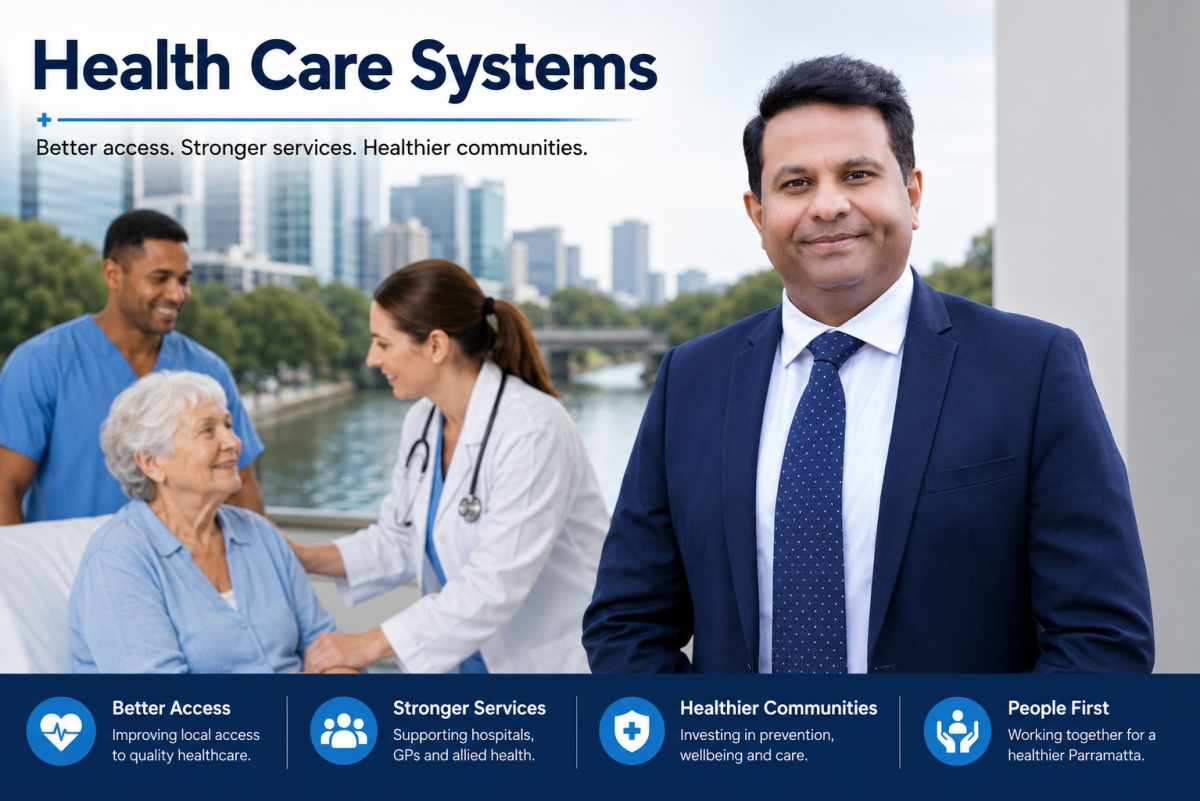
A parent who cannot get a same-day GP appointment, an older resident waiting too long in emergency, a carer travelling across suburbs for specialist treatment – these are not abstract policy issues.
They are everyday realities that shape how people live in our community. When we talk about health care services and the importance of a better health system in the Parramatta electorate, we are really talking about time, dignity, safety and whether local families can get help when they need it.
For residents, health is not split neatly between levels of government.
People do not care which office funds what when they are trying to book a doctor, access mental health support or get an ageing parent into the right service. They want a system that works. That is why local leadership matters.
Councils may not run hospitals, but we do see where the pressure points land – in traffic around major health precincts, in housing stress, in social isolation, in community safety, in access for seniors and in the public spaces that support healthy daily life.
Why health care services in Parramatta electorate matter locally
Parramatta is growing quickly, and that growth brings both opportunity and pressure.
More families, more apartment living, more older residents wanting to age with dignity, and more culturally diverse communities all place different demands on the health system. A one-size-fits-all approach does not work here.
For many local residents, access is the first issue.
A service may technically exist, but if it is too far away, too expensive, too hard to navigate, or not available in a language a person understands, it is not truly accessible.
Better health care is not only about more beds or more buildings. It is about whether services meet people where they are.
There is also a strong link between health services and economic confidence. When workers cannot access timely care, small businesses feel it.
When families spend hours travelling to appointments, household pressure grows. When preventive care is delayed, costs rise later for everyone.
Better health outcomes are not just good social policy – they support a stronger, more stable local community.
The importance of a better health system in the Parramatta electorate
The phrase may sound broad, but the importance of a better health system in the Parramatta electorate becomes clear very quickly when we look at daily life.
A better system means earlier diagnosis, less avoidable illness, shorter waits, more confidence for families and less pressure on emergency departments.
It also means fairness. In a diverse area like ours, residents come from many cultural backgrounds and life circumstances.
Some are new migrants learning how Australian services work. Some are seniors managing several conditions at once. Some are young families balancing work, school and care responsibilities.
A better system recognises these differences instead of expecting everyone to fit the same pathway.
There is another side to this as well. Better systems are not built only in moments of crisis.
They are built through planning, cooperation and honest attention to gaps before they become failures.
That includes local infrastructure, transport links, public amenities, accessible community buildings and safer streets around busy health precincts.
These may sound separate from medicine, but they directly affect whether people can actually use health services.
Where residents feel the strain most
In conversations across the community, a few themes come up again and again. Access to GPs remains uneven, especially for families needing urgent but non-emergency care.
Mental health support is still difficult to secure quickly, particularly for young people and carers.
Specialist care can involve long waits, repeated referrals and travel burdens that are hard for working households.
Older residents often face a different challenge. They may need regular appointments, mobility-friendly public spaces and clearer support close to home.
If footpaths are poor, seating is limited, parking is difficult or community transport is stretched, the health system becomes harder to use even before someone reaches a clinic.
Residents from multicultural backgrounds can face language and trust barriers too. Interpretation, culturally responsive care and simple communication matter. If people are unsure how to access a service, what they are eligible for, or where to go next, delays follow. In health, delays can become bigger problems very quickly.
What council can do, and what it cannot
It is important to be honest about roles. Local council does not control hospitals or the broader state and federal health system.
But council does shape many of the conditions that affect health and can advocate strongly when local needs are not being met.
That includes planning for community facilities, improving local roads and footpaths near key services, supporting active transport, strengthening public spaces, backing community programs that reduce isolation and ensuring growth is matched by infrastructure.
Council decisions around development, traffic, accessibility, parks and community centres all have a health impact.
Advocacy matters too. A councillor’s role is not only to vote in chambers. It is to listen carefully, raise concerns consistently and push for practical outcomes with the agencies that hold responsibility.
Residents expect local representatives to be visible and responsive, especially when service pressure is affecting daily life. That expectation is fair.
A practical, people-first approach to better health outcomes
The best local approach is not grandstanding. It is steady, practical work focused on what residents are actually experiencing.
That means listening to families who struggle to get appointments, speaking up for safer and more accessible neighbourhoods, and making sure rapid growth does not outpace community needs.
As a councillor, the most useful contribution is often to connect the dots.
If residents raise concerns about congestion near health facilities, that is a transport issue and a health access issue.
If families feel isolated in high-density areas, that is a community wellbeing issue as much as a planning one.
If seniors cannot comfortably reach local services, that is not just about ageing – it is about urban design, dignity and inclusion.
This is where local government can be at its best: close enough to see problems early, practical enough to act on local conditions, and persistent enough to advocate for bigger system improvements.
What better health care services should look like here
A better local health picture for Parramatta would include timely access to primary care, stronger mental health pathways, culturally responsive support, safer and easier movement around key service areas, and more community-based prevention.
It should also include clearer information so residents know what help exists and how to use it.
Prevention deserves more attention than it often gets. Parks, walking paths, recreation spaces, community programs and social connection all contribute to better health. So do cleaner streets, safer crossings and public places that encourage people to be active and engaged.
These are not extras. They are part of a healthier suburb.
At the same time, we should be realistic about trade-offs.
Growth can help justify better services, but if development moves faster than infrastructure, strain increases.
A major health precinct can bring jobs and investment, but also parking pressure, congestion and local disruption.
Good planning means recognising both sides and working to reduce the burden on residents.
What residents can reasonably expect from local leadership
Residents should expect honesty, availability and follow-through.
Not every issue can be fixed at council level, but every serious concern deserves attention and proper advocacy. People want representatives who understand that health is not only a hospital matter.
It affects housing, transport, local safety, social cohesion and confidence in government.
They should also expect their local leaders to keep pushing for better coordination between council, state agencies and community organisations.
Too often, residents are left to navigate fragmented systems on their own.
A service-minded approach means helping cut through that confusion wherever possible.
For a place as dynamic and diverse as Parramatta, the standard should be higher than basic adequacy.
Families should feel that care is reachable. Seniors should feel that their suburb supports independence.
Young people should know help is available before a crisis. And multicultural communities should feel seen, respected and understood by the systems meant to serve them.
Good health policy is often discussed in statistics, budgets and waiting times. Those things matter.
But at community level, the real test is simpler.
Can a resident get help without unnecessary delay, confusion or hardship? If the answer is too often no, then better coordination, better planning and stronger advocacy are not optional.
That is why this issue deserves attention not only from health departments, but from every level of leadership that claims to put people first.
A better health system is, at heart, a promise to the community that no one should be left struggling alone when support ought to be within reach.
