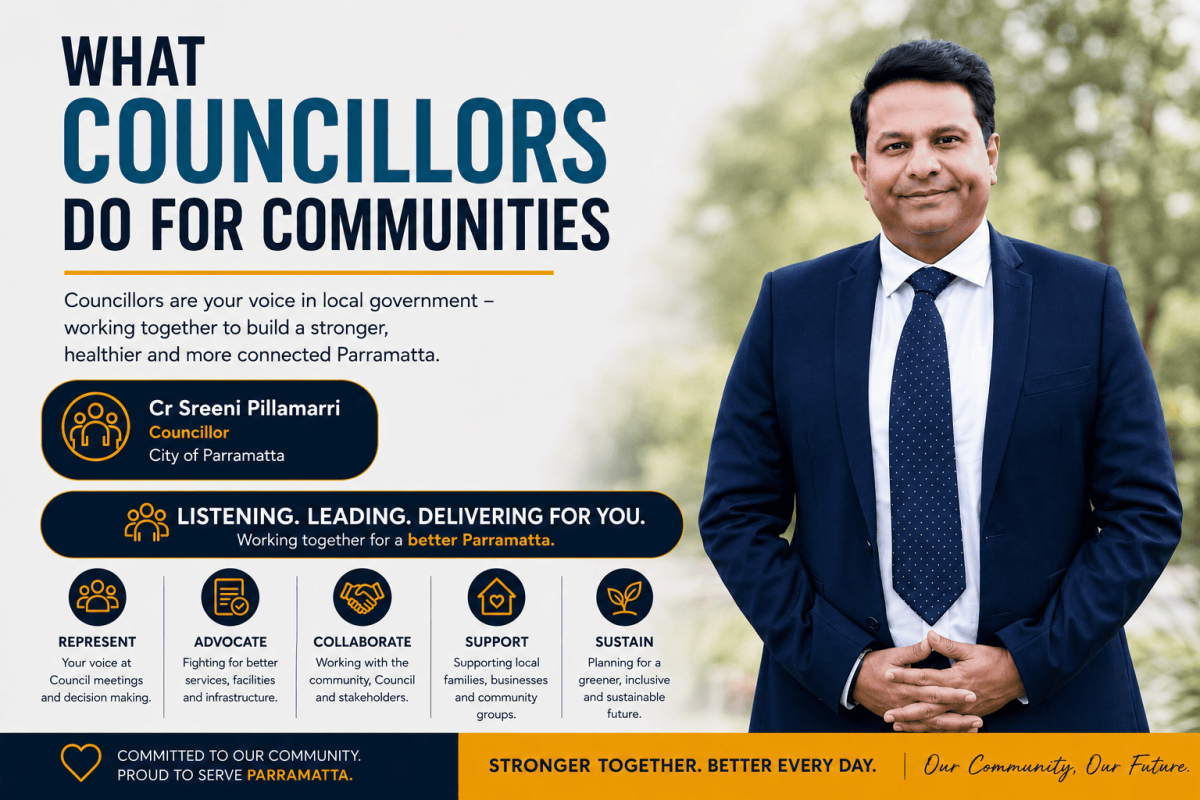
When a resident raises concerns about a dangerous intersection, missed rubbish collection, overdevelopment, park upgrades or community safety, they are usually not asking for grand political speeches.
They want action, follow-up and someone who understands how local decisions affect daily life.
That is the heart of what councillors do for communities.
A councillor sits at the point where public concern meets public decision-making.
In local government, that means listening carefully, weighing competing needs and helping shape the policies, budgets and priorities that affect neighbourhoods every day.
For families, business owners, seniors, young people and multicultural communities, a good councillor should be visible, accessible and willing to do the work behind the scenes as well as in public.
What councillors do for communities in practice
Many people assume councillors simply attend meetings and vote. Meetings are part of the role, but they are only one part.
Much of the work happens before and after the chamber.
It includes reading reports, meeting residents, understanding local concerns, speaking with council staff, attending community events and pushing for outcomes that reflect what people are actually experiencing on the ground.
In practical terms, councillors help set the direction of council.
They consider how money is spent, which projects are prioritised and whether proposed developments, services or strategies are in the community’s long-term interest.
That can cover everything from roads, footpaths and drainage to libraries, playgrounds, sports facilities, waste services, public spaces and cultural programs.
This is also where the role becomes more complex than many people realise.
Good local decision-making is not just about saying yes to popular ideas.
Sometimes it involves balancing growth with liveability, infrastructure with environmental concerns, or immediate pressure with long-term planning.
Residents rightly expect councillors to hear them clearly, but they also expect judgement.
Representing local voices, not just local issues
One of the most important parts of what councillors do for communities is representation.
That means more than passing on complaints.
It means understanding patterns in what residents are saying and turning those concerns into better advocacy and better policy.
For example, if multiple families raise traffic risks around schools, the issue is not only one street or one crossing.
It may point to a broader need for road safety upgrades, better parking management or stronger coordination with state agencies.
If local traders are worried about access during construction, the councillor’s role is not simply to sympathise.
It is to press for practical solutions that reduce disruption and support local business activity.
In a growing area like Parramatta, representation matters because change is constant.
More housing, transport projects, new businesses and shifting demographics create opportunity, but they can also create strain.
Residents want to know that growth will not come at the expense of amenity, safety or community connection. Councillors help bring that local perspective into formal decision-making.
The community role goes beyond complaints
People often contact councillors when something has gone wrong, and that is understandable.
But the role is also about building positive outcomes before problems become bigger.
Supporting festivals, sporting groups, seniors programs, multicultural events and local initiatives helps strengthen social connection and civic trust.
That work may not always attract headlines, but it matters.
A well-supported neighbourhood centre, an upgraded park, a safer pedestrian link or a successful local event can change how connected people feel to where they live.
Communities are not held together by policy documents alone. They are strengthened by local spaces, services and relationships.
Decision-making on budgets, planning and services
Councillors are elected to make decisions, and some of the most important ones are not glamorous.
Budget discussions, strategic plans, development controls and service reviews can sound technical, but they shape everyday life in very real ways.
A budget is not just numbers on a page. It is a statement of priorities. It shows whether enough support is going to roads, parks, community facilities, waste services, public health measures, environmental projects and neighbourhood infrastructure.
Councillors need to ask practical questions: Which suburbs are missing out? Are upgrades being delivered fairly? Are residents getting value?
Are long-term maintenance costs being considered, not just ribbon-cutting moments?
Planning decisions are equally significant. Residents often feel the effects of planning long before they understand the rules behind it.
Height, density, traffic, overshadowing, tree canopy, parking and stormwater all affect how an area functions.
Councillors do not control every development outcome, and state planning settings can limit local influence, but they do play a role in reviewing proposals, setting policy frameworks and advocating for better standards.
This is where honesty matters. Not every issue can be fixed at council level.
Sometimes the problem sits with state government, utility providers or private developers.
A dependable councillor should be upfront about those limits while still helping residents navigate the process and pushing for fair outcomes.
Being accessible when residents need help
A strong councillor is not only someone who speaks well in meetings. They are someone residents feel they can approach.
Accessibility builds trust, especially for people who may not know how council works or who feel shut out of official systems.
That can mean helping a resident understand where to direct a concern, explaining a council process in plain English, following up on service issues or making sure someone is not ignored when the matter is urgent.
It also means being present in the community, not just during election periods.
For multicultural communities, this is especially important. Many residents bring rich experience, strong values and deep commitment to family and neighbourhood life, but they may still find local government hard to navigate.
A councillor who listens with patience and respect can make civic participation feel more open and less intimidating.
That people-first approach has always mattered to me as Councillor.
The role is not about being distant from the community. It is about being available, accountable and prepared to work through issues with residents in a practical way.
Advocacy beyond the council chamber
Local government does not operate in isolation.
Some of the biggest issues facing residents involve state roads, transport, schools, hospitals, housing pressures and cost-of-living challenges.
Councillors cannot solve all of these directly, but they can advocate strongly and consistently.
This part of the role is often overlooked. Advocacy means making sure local concerns are not lost when decisions are made elsewhere.
If an intersection needs attention from a state authority, if public transport gaps are hurting commuters, or if infrastructure is lagging behind population growth, councillors can help keep pressure on the relevant bodies.
Good advocacy is grounded in evidence and local knowledge.
It is most effective when it combines residents’ lived experience with clear policy requests.
It also requires persistence. Some issues are resolved quickly.
Others take repeated representations, partnerships and public attention over time.
Trade-offs are part of the job
There is no serious councillor role without difficult choices. A new facility may be popular, but funding may be limited. Housing may be needed, but residents may worry about congestion and character.
Environmental goals may be widely supported, but implementation can affect rates, construction timelines or land use.
That is why community trust depends on more than agreement. It depends on transparency.
Residents may accept a decision they do not fully like if they believe the process was fair, their concerns were heard and the reasons were explained honestly.
Why local leadership still matters
When local government works well, people feel it in ordinary ways. Streets are safer. Parks are cleaner.
services are easier to access. Families feel more confident using public spaces.
Local businesses see investment in the area.
Community groups feel supported rather than forgotten.
When it works poorly, frustration builds fast. People feel unseen, developments feel imposed and everyday issues drag on longer than they should.
That is why councillors matter. They are one of the closest forms of elected representation people have.
The best councillors do not pretend to have all the answers. They ask questions, stay connected, respond to concerns and keep working on the issues that shape daily life.
They also understand that community confidence is earned slowly – through reliability, visibility and follow-through.
For residents, knowing what councillors do for communities can make it easier to engage with council and expect better from local leadership.
For councillors, the responsibility is simple even when the work is not: listen well, act with integrity and keep the community at the centre of every decision.
If local government is doing its job properly, residents should not have to fight to be heard on every issue.
They should feel there is someone paying attention, asking the right questions and working steadily to make their neighbourhood a better place to live.